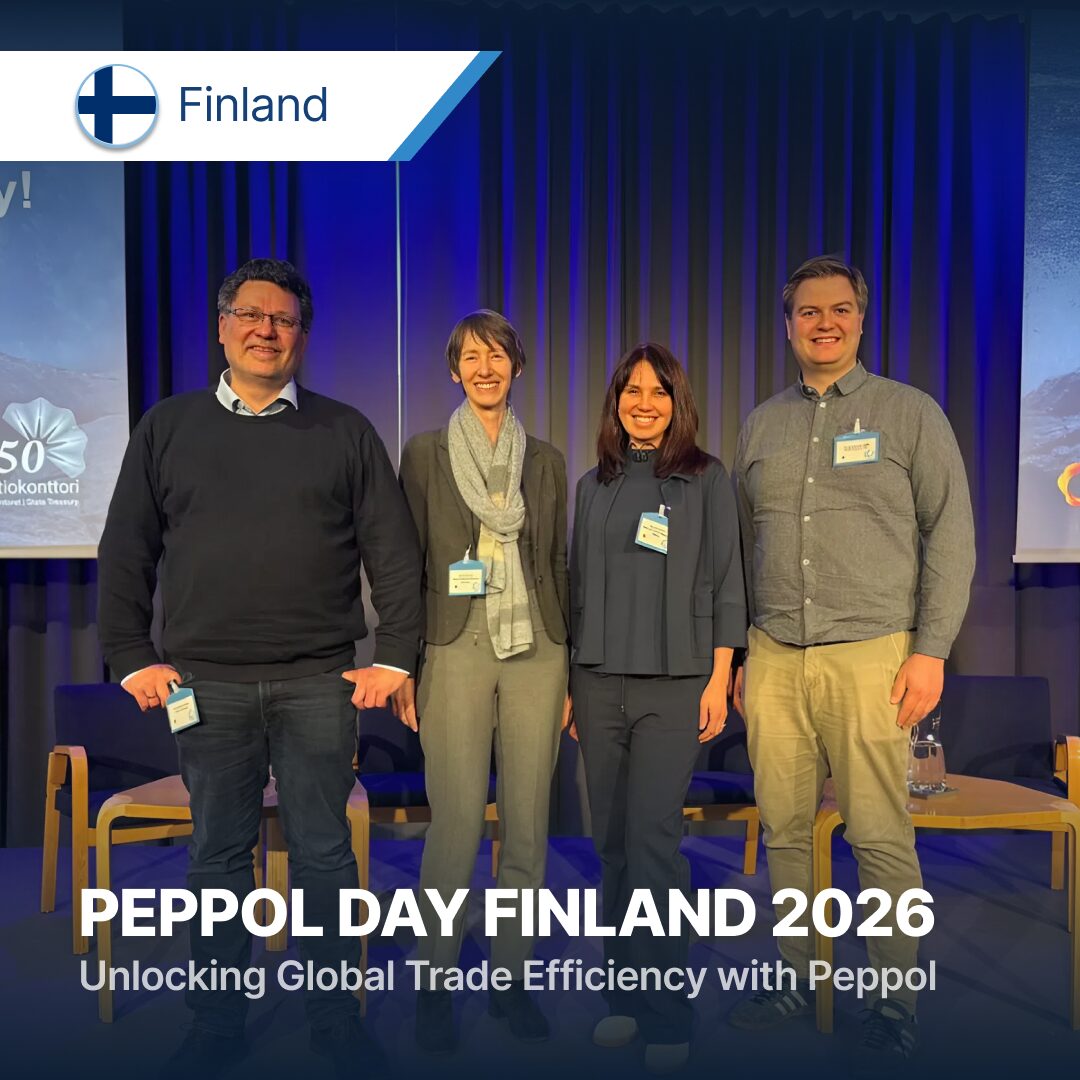
Peppol Day Finland 2026: From E-Invoicing to a Global Digital Language
Peppol is rapidly evolving beyond e-invoicing into a global standard for digital business communication. Key takeaways from Peppol Day Finland 2026.
On April 21, our Managing Director attended Peppol Day Finland 2026, where one key message stood out: Peppol is rapidly evolving beyond e-invoicing into a global standard for digital business communication.
The central theme of the event — "Unlocking Global Trade Efficiency with Peppol" — reflects a broader shift happening across Europe and beyond. Peppol is no longer just about invoices. It is becoming a shared digital language connecting companies, systems, and governments.
The conference opened with a powerful statement:
"Connection between countries, between companies. Share standards, share progress."
This captures the direction of the entire ecosystem. Peppol is now positioned as a framework that enables not only invoicing, but also ordering, logistics, and reporting, all within one interoperable network.
Finland continues to set the benchmark for e-invoicing maturity:
Years of experience in e-invoicing
Adoption rate across the country
Invoices processed annually
The country is now transitioning fully to Peppol, moving away from national formats like Finvoice and TEAPPSXML. The Finnish Peppol Authority emphasized a clear strategy: avoid creating new country-specific solutions when international standards already exist.
Peppol is now considered part of Finland's critical infrastructure, and the government is actively expanding its use. Since April 2024, Advanced Ordering has been introduced, with the goal of doubling e-order transactions each year.
The Netherlands provides a strong example of market-driven adoption:
Sent via Peppol network
Active network members
Certified and active
Year-over-year expansion
Security & Collaboration: Their success is built on collaboration between service providers, national authorities, and software vendors. Security frameworks such as eIDAS and NIS2 ensure trust and compliance across the network.
The upcoming VAT in the Digital Age (ViDA) initiative will significantly reshape the landscape:
Mandatory Digital Real-Time Reporting (DRR)
Deadline set for July 1, 2030
This will require near real-time transmission of invoice data to tax authorities. Even advanced markets like Finland consider the timeline ambitious.
For businesses, the key requirement is clear: a smooth transition without technical barriers.
Germany is undergoing major technical changes aligned with European standards:
approved and expected mid-2026
planned for late 2026
Key updates include:
These changes will require significant updates from service providers and software systems.
One of the most important takeaways from the event is the expansion of Peppol beyond invoicing.
The future document flow is expected to look like this:
This end-to-end approach enables full digitalization of the procurement and supply chain process.
Peppol adoption is no longer limited to Europe.
Japan joined the network in 2024 and is already progressing rapidly. While many organizations currently receive invoices via Peppol, outbound processes are still evolving, with a transition from PDF-based workflows to fully structured data exchange.
Peppol Day Finland clearly demonstrated that the role of Access Points is expanding.
It is no longer just about sending invoices. Businesses need solutions that support:
Multiple document types across the supply chain
Compliance with evolving regulations
Cross-border interoperability
Secure and scalable data exchange
Peppol is becoming the backbone of digital trade.
As adoption accelerates and regulations like ViDA come into force, businesses must be ready to operate in a fully digital, standardized environment.
For companies using an Access Point, this is a strategic opportunity — not just to stay compliant, but to optimize and future-proof their entire document exchange process.
Germany’s 2026 E-Invoicing Update: What the New BMF Letter Changes
/in eInvoice NewsThe BMF letter of 15 October 2026 says a business-rule error is still an e-invoice for VAT, writes the Kontrollfunktion into the UStAE, and extends two concessions to June 2030.
Luxembourg Plans Mandatory B2B E-Invoicing from 2028 — via Peppol
/in eInvoice NewsLuxembourg has proposed a phased B2B e-invoicing mandate starting in 2028. Bill 8815 would require businesses to receive and issue structured e-invoices through a common Peppol-based delivery network.
Greece Postpones Phase B of B2B E-Invoicing but 1 February 2027 Is the Date to Watch
/in eInvoice NewsGreece has moved Phase B of its B2B e-invoicing mandate to 2 November 2026. But the more important deadline comes on 1 February 2027, when direct ERP-to-myDATA transmission will no longer be permitted. Here is what businesses need to prepare for.
XRechnung 4.0: The Preview Is Out, and the Standard Underneath It Has Changed
/in eInvoice NewsKoSIT has released a preview of XRechnung 4.0 and EN 16931-1:2026 is ratified. 50+ new business terms, multiple orders per invoice — and parallel operation until March 2029.
How to Implement E-Invoicing Without Replacing Your ERP: A 5-Step Guide
/in eInvoice NewsThe most expensive misconception about e-invoicing is that it requires new accounting software. Discover the honest 5-step process to get compliant, from cleaning master data to choosing the right converter.
XRechnung, ZUGFeRD, Factur-X, Peppol BIS: Which One Do You Actually Need?
/in eInvoice NewsFour names, two questions. What is a format, what is a network, and how to work out in five minutes which combination your customer requires — with a free file check.
GEBA: Germany Finally Has a B2B E-Invoicing Address and It Is Coming to Peppol
/in eInvoice NewsThe German Electronic Business Address turns one this month and is being registered in the Peppol EAS code list. What GEBA is, how it differs from the Leitweg-ID, and how to build one.