Peppol Day Finland 2026: From E-Invoicing to a Global Digital Language
Peppol is rapidly evolving beyond e-invoicing into a global standard for digital business communication. Key takeaways from Peppol Day Finland 2026.
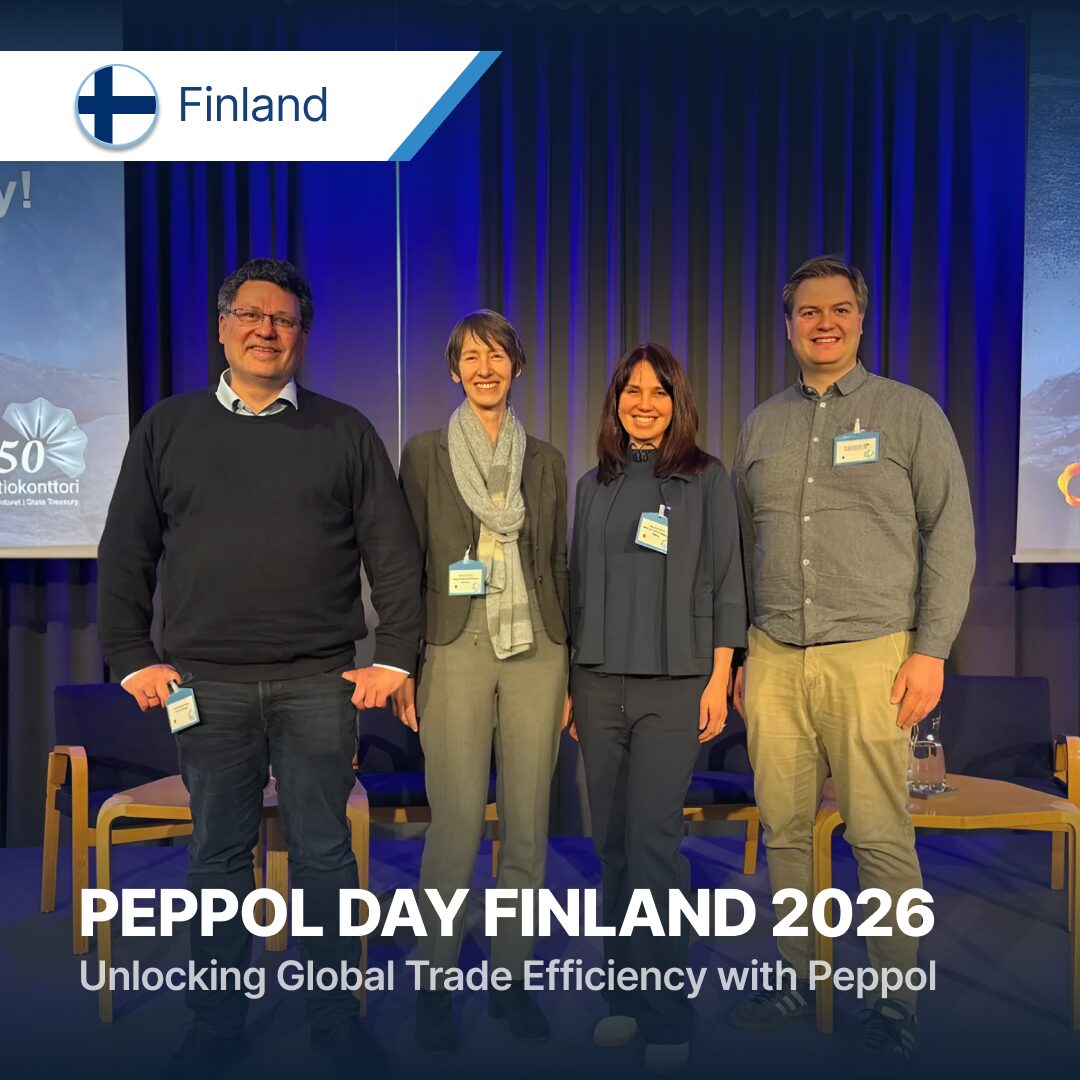
On April 21, our Managing Director attended Peppol Day Finland 2026, where one key message stood out: Peppol is rapidly evolving beyond e-invoicing into a global standard for digital business communication.
The central theme of the event — "Unlocking Global Trade Efficiency with Peppol" — reflects a broader shift happening across Europe and beyond. Peppol is no longer just about invoices. It is becoming a shared digital language connecting companies, systems, and governments.
The conference opened with a powerful statement:
"Connection between countries, between companies. Share standards, share progress."
This captures the direction of the entire ecosystem. Peppol is now positioned as a framework that enables not only invoicing, but also ordering, logistics, and reporting, all within one interoperable network.
Finland continues to set the benchmark for e-invoicing maturity:
Years of experience in e-invoicing
Adoption rate across the country
Invoices processed annually
The country is now transitioning fully to Peppol, moving away from national formats like Finvoice and TEAPPSXML. The Finnish Peppol Authority emphasized a clear strategy: avoid creating new country-specific solutions when international standards already exist.
Peppol is now considered part of Finland's critical infrastructure, and the government is actively expanding its use. Since April 2024, Advanced Ordering has been introduced, with the goal of doubling e-order transactions each year.
The Netherlands provides a strong example of market-driven adoption:
Sent via Peppol network
Active network members
Certified and active
Year-over-year expansion
Security & Collaboration: Their success is built on collaboration between service providers, national authorities, and software vendors. Security frameworks such as eIDAS and NIS2 ensure trust and compliance across the network.
The upcoming VAT in the Digital Age (ViDA) initiative will significantly reshape the landscape:
Mandatory Digital Real-Time Reporting (DRR)
Deadline set for July 1, 2030
This will require near real-time transmission of invoice data to tax authorities. Even advanced markets like Finland consider the timeline ambitious.
For businesses, the key requirement is clear: a smooth transition without technical barriers.
Germany is undergoing major technical changes aligned with European standards:
approved and expected mid-2026
planned for late 2026
Key updates include:
These changes will require significant updates from service providers and software systems.
One of the most important takeaways from the event is the expansion of Peppol beyond invoicing.
The future document flow is expected to look like this:
This end-to-end approach enables full digitalization of the procurement and supply chain process.
Peppol adoption is no longer limited to Europe.
Japan joined the network in 2024 and is already progressing rapidly. While many organizations currently receive invoices via Peppol, outbound processes are still evolving, with a transition from PDF-based workflows to fully structured data exchange.
Peppol Day Finland clearly demonstrated that the role of Access Points is expanding.
It is no longer just about sending invoices. Businesses need solutions that support:
Multiple document types across the supply chain
Compliance with evolving regulations
Cross-border interoperability
Secure and scalable data exchange
Peppol is becoming the backbone of digital trade.
As adoption accelerates and regulations like ViDA come into force, businesses must be ready to operate in a fully digital, standardized environment.
For companies using an Access Point, this is a strategic opportunity — not just to stay compliant, but to optimize and future-proof their entire document exchange process.

Peppol Day Finland 2026: From E-Invoicing to a Global Digital Language
/in eInvoice NewsPeppol is rapidly evolving beyond e-invoicing into a global standard for digital business communication. Key takeaways from Peppol Day Finland 2026.
ViDA, EN 16931 and the future of e‑Reporting
/in eInvoice NewsThe VAT in the Digital Age (ViDA) initiative will overhaul VAT reporting by 2030. Learn how the updated EN 16931 standard enables the future of e‑Reporting.
France: Preparing for the e‑Invoicing & e‑Reporting Mandate
/in eInvoice NewsFrance is embarking on a major digital overhaul of VAT compliance. Every French‑established business must be able to receive electronic invoices from 1 September 2026, with the largest companies also required to issue e‑invoices and transmit transaction data from that date.
New BMF Clarifications on Mandatory E‑Invoicing: What You Need to Know
/in eInvoice NewsThe Federal Ministry of Finance published new guidance on E‑Rechnung requirements, error handling, transition periods and validation — here’s what it means for your business.
DORA and e‑invoicing: assessing criticality
/in eInvoice NewsThe Digital Operational Resilience Act (DORA) sets uniform rules for digital resilience in the financial sector — what does this mean for e‑invoicing providers?
Greece: the e‑Invoicing mandate is pushed back
/in eInvoice NewsGreece is modernising the way companies issue and report invoices with structured electronic invoices validated via the myDATA platform, now with extended deadlines.
Mandatory E-Invoicing in Poland
/in eInvoice NewsPoland is moving forward with a major compliance change: mandatory electronic invoicing (e-invoicing) through the National e-Invoicing System (KSeF). This reform will transform how businesses issue and receive invoices.